
Ads in ChatGPT help advertisers reach users as they explore, compare, and decide within a single conversational experience. By considering the context of the current conversation and, when ads personalization is enabled, select signals from a user’s broader ChatGPT experience, ChatGPT Ads create opportunities to deliver relevant, helpful messages aligned with what users are trying to accomplish.
Who may see ads
We do not show ads to users on Plus, Pro, or any Business plan, or to any accounts identified as belonging to users under 18, based on account-level age information and age prediction where available.
Ad format
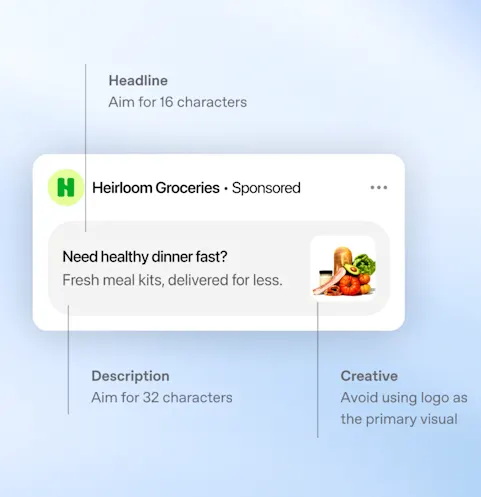
Ads appear below ChatGPT responses. Each ad includes:
Advertiser name
Favicon (advertiser logo)
Title (headline)
Copy (description)
Landing page
Image asset (creative)
See below for an example ad unit.
Selection and delivery
Our ads system selects and delivers ads based on expected relevance and outcomes. It considers multiple signals, including the context and intent of the current conversation, the ad’s landing page, title, copy, advertiser-provided context hints, and, when ads personalization is enabled, select signals from a user’s broader ChatGPT experience.
At the ad group level, advertisers can provide context hints that describe the conversations, topics, or keywords where their products or services may be relevant. These hints help guide ad matching, but they are not exact-match keywords and do not guarantee delivery in specific conversations.
Pricing
ChatGPT Ads supports impression and valid-click billing. Choose Views for impression-based buying, Clicks to optimize for traffic, or Conversions to optimize toward a supported standard conversion event. Conversion-optimized campaigns with click billing (oCPC) charge for valid clicks, not conversions. For eligibility and other conversion-optimized billing options, see Conversion-optimized Campaigns.
Advertisers set a maximum bid at the ad-group level: a maximum CPM bid for Reach campaigns or a maximum CPC bid for Clicks campaigns. For CPC campaigns, we recommend starting with a maximum bid of $3–$5 USD per click. Ads Manager may also provide bid-strength guidance to indicate whether a bid is likely to be competitive or may limit delivery.
We use a relevance-weighted, second-price auction to select among eligible ads. Our system aims to maximize both advertiser and user value.
Tracking and measurement
Ads Manager Beta reporting currently includes impressions, clicks, spend, click-through rate (CTR), average CPC, average CPM, and conversions.
To measure conversions from ChatGPT Ads, advertisers can set up conversion measurement in Ads Manager Beta. For step-by-step guidance, visit our measurement documentation.
Advertisers can also track traffic from ChatGPT Ads by adding static tracking parameters (e.g. UTM parameters) to landing page URLs. These parameters persist on ad clicks and can be used in existing analytics tools to understand traffic from ChatGPT Ads.
Impressions, clicks, and CTR refresh approximately every 15 minutes. Spend insights may be delayed 7–8 hours, so a displayed spend of zero does not necessarily mean no charges have accrued. Reporting times can vary.
Brand safety
OpenAI’s policy is to place ads only near chats that are safe, appropriate, and aligned with user trust and brand safety. Our safeguards are designed to prevent ads from appearing in sensitive user contexts or brand-unsafe environments, including the contexts outlined in our Ads Policies.