
2026 年 5 月 28 日
ChatGPT 工作區智慧體的新控制項與功能
我們正為 Enterprise 與 Edu 中的 ChatGPT 工作區智慧體推出新的模型、管理、應用程式存取與回應功能。
工作區智慧體現在支援:
GPT-5.5 與推理強度控制:建立智慧體時,建立者可選擇 GPT-5.5,並設定智慧體使用的推理強度。我們也提升了所有智慧體的回應速度。
基於角色的發布權限:工作區管理員可控制哪些角色能將智慧體發布到共享工作區目錄。
引導式智慧體設定:ChatGPT 現在會提出設定問題,協助使用者更快建立實用的智慧體。
語音輸出:智慧體現在可將音訊檔案作為回應的一部分建立。
更智慧的 Slack 討論串回覆:在 Slack 中使用的智慧體,於首次被提及後,可對討論串中相關的後續訊息作出回應。建立者可選擇讓智慧體回應相關的討論串訊息,或僅在被提及時回應。
適用於 GitHub Enterprise、Snowflake 與 Databricks 的應用程式範本
Enterprise 與 Edu 方案的工作區管理員與擁有者,現在可使用 ChatGPT 應用程式範本,為 GitHub Enterprise、Snowflake 與 Databricks 建立工作區專屬應用程式。應用程式範本會提供引導式設定流程,協助處理供應商專屬設定,例如 OAuth 憑證、回呼 URL、Webhook 詳細資訊、受管理的 MCP 伺服器 URL,以及工作區存取控制,之後管理員再將應用程式發布給成員。
使用新的設定指南了解一般應用程式範本流程,以及各範本的供應商專屬步驟:ChatGPT 應用程式範本、GitHub Enterprise 應用程式範本、Snowflake 應用程式範本與Databricks 應用程式範本。
發布後,管理員可在工作區設定 > Apps > Enabled 中管理產生的應用程式,包括角色存取、動作控制與動作確認。
May 22, 2026
Workspace agents are now generally available in ChatGPT Business, Enterprise, and Edu.
Workspace agents help teams get more done together across tools. They can own entire workflows on their own, follow team processes, and be shared across your team so people can build once and use together.
We’ve also added new admin controls and visibility:
Agent builders can set safeguards on which actions agents can take for each app enabled in their workspace.
Business, Enterprise, and Edu admins can view workspace agent activity and usage in the
.
We’ve extended the free period for workspace agents until July 6, 2026. Credit-based pricing will begin on that date. (edited)
2026 年 5 月 21 日
Codex 更新:目標模式、瀏覽器改進、遠端鎖定使用、管理分析與外掛程式分享狀態
Codex 現在為 Enterprise 與 Edu 使用者提供更多方式,可朝較長時程目標推進並在瀏覽器中反覆迭代;符合資格的管理員也可獲得更新後的使用分析:
macOS 應用程式中的 Appshots 可讓使用者透過快捷鍵將應用程式視窗附加到 Codex 執行緒,包含螢幕截圖與可用文字。Appshots 現已適用於 ChatGPT Edu 帳戶,對 ChatGPT Enterprise 帳戶的支援即將推出。
目標模式現已在 Codex 應用程式、IDE 擴充功能與 CLI 中正式推出,讓使用者可定義目標結果與成功條件,並讓 Codex 持續朝該目標努力。
應用內瀏覽器註解 為瀏覽器型與前端工作提供更精準的樣式回饋。
鎖定狀態下的電腦使用 讓使用者在 Mac 鎖定後,仍可讓 Codex 在遠端安全運作,但須遵守既有地區限制。管理員與擁有者可在 Codex cloud 的Policies & Configurations設定中,將
remote_computer_use = false來關閉此功能。請查看設定參考以了解更多細節。瀏覽器使用改進新增進階註解模式、更快的資產擷取、唯讀 JavaScript 情境、分頁群組易用性、更少的 Chrome 擴充功能分頁雜亂,以及可靠性改進。
全球管理主控台現在包含 Enterprise 管理員的 Codex 分析,提供活躍使用者、點數與 Token、執行緒與回合數、使用者排行榜、外掛程式使用情況、已接受程式碼行數、模型使用情況,以及與主控台一致的 UI。
外掛程式分享可讓團隊從 Codex 應用程式與工作區成員分享本機建置的外掛程式。對於 ChatGPT Enterprise,外掛程式分享預設為停用——請聯絡你的 OpenAI 帳戶聯絡人,以了解如何啟用此功能。對於 ChatGPT Edu 帳戶,外掛程式分享預設為啟用。
了解更多:目標模式、鎖定狀態下的電腦使用、應用內瀏覽器註解與外掛程式分享。
工作區智慧體現已在 ChatGPT Business、Enterprise 與 Edu 中正式推出。
工作區智慧體可協助團隊跨工具共同完成更多工作。它們可自行負責完整工作流程、遵循團隊流程,並可在團隊中共享,讓人們建立一次即可共同使用。
我們也新增了管理控制與可視性:
智慧體建立者可針對工作區中各已啟用的應用程式,設定智慧體可採取哪些動作的防護措施。
Business、Enterprise 與 Edu 管理員可在
管理主控台中檢視工作區智慧體活動與使用情況。
我們已將工作區智慧體的免費期間延長至 2026 年 7 月 6 日。屆時將開始採用點數計費。
2026 年 5 月 18 日
從 Apps Directory 與應用程式建立流程移除 Beta 標籤
我們已從網頁版與桌面版 ChatGPT 中的 Apps Directory,以及新的應用程式建立流程中移除 Beta 標籤。
這只是標示更新。這不會改變 Apps Directory 體驗、應用程式建立工作流程、開發模式能力,或開發模式現有的高風險指引。
2026 年 5 月 15 日
在 ChatGPT 中推出具管理員管理同步功能的 Microsoft Teams 應用程式
具管理員管理同步功能的 Microsoft Teams 應用程式 現已開放給符合資格的 ChatGPT Enterprise 與 Edu 工作區。擁有者與管理員可為整個工作區一次性連接 Microsoft Teams,使 ChatGPT 能參考成員已具備權限存取的 Teams 訊息與對話中繼資料。
擁有者與管理員可從工作區設定 → Apps 啟用同步,透過範圍選擇器與可選的 Microsoft Purview 敏感度標籤篩選器選擇要納入的 Teams 內容,然後透過「部署到你的團隊」進行部署。此同步體驗僅供讀取,設定後可能需要一些時間才能完全填入內容,且與一般自助式 Microsoft Teams 應用程式分開。
2026 年 5 月 14 日
Codex 遠端存取與自動化存取權杖
Codex 現在支援從 ChatGPT 行動應用程式進行遠端存取,讓使用者可持續連線至較長時程的工作、回答問題、重新導向執行、核准動作、審閱輸出,以及在 Codex 持續於底層 Mac 主機或已連接遠端環境中運作時,在不同已連接主機間切換。行動體驗會呈現該環境的即時狀態,包括專案脈絡、核准、螢幕截圖、終端機輸出、差異與測試結果。Enterprise 工作區也可為受信任、非互動式的本機工作流程使用 Codex 存取權杖,讓這些流程在無需瀏覽器登入的情況下,也能使用 ChatGPT 工作區身分與企業控制。
若要試用,請同時更新 ChatGPT 行動應用程式與 macOS 上的 Codex 應用程式。行動設定可能需要工作區已啟用的 Remote Control 存取,且可能涉及 SSO、多重要素驗證或通行金鑰步驟。
此外,ChatGPT Enterprise 工作區現已提供存取權杖;管理員可管理工作區層級的可用性,具備許可角色的成員可建立自己的權杖,而在可用情況下,治理介面也會反映存取權杖活動。
Remote control 預設為關閉,管理員/擁有者可從工作區設定啟用。
請在Remote connections、Access tokens、Admin setup 與 Governance 中了解更多。
2026 年 5 月 7 日
ChatGPT 工作區智慧體現已支援使用 EKM 的 Enterprise 工作區
ChatGPT 工作區智慧體現已開放給符合資格、使用企業金鑰管理(EKM)的 ChatGPT Enterprise 工作區。
工作區智慧體可讓組織在已連接應用程式(包括 ChatGPT 與 Slack)中,為可重複任務與商務工作流程建置及使用智慧體。智慧體可由範本建立或從零開始,在發布前預覽、於工作區內分享,並依排程執行。
符合資格的 EKM 工作區現在可建立與使用工作區智慧體、連接支援的工具與應用程式、加入技能、檔案與自訂 MCP 伺服器、安排定期執行、在已連接的 Slack 頻道中使用智慧體,以及檢視版本歷史與分析。
工作區智慧體預設仍為關閉。管理員可透過管理控制,為符合資格的工作區啟用智慧體建置、發布與 Slack 使用。
2026 年 5 月 6 日
適用於 iOS 與 iPadOS 的 ChatGPT for Intune
我們已將 ChatGPT for Intune 加入 Apple App Store。ChatGPT for Intune 是為透過 Microsoft Intune 與 Microsoft Entra 管理行動存取管理的 ChatGPT Enterprise 組織所提供的獨立 iOS 應用程式。此應用程式可讓 IT 團隊將 Microsoft 應用程式保護原則與條件式存取原則套用至 iOS 與 iPadOS 上的 ChatGPT 行動體驗。
ChatGPT for Intune 僅適用於 Enterprise 帳戶,且使用前需先由組織完成與 OpenAI 的導入。Enterprise 擁有者與管理員應聯絡其 OpenAI 客戶總監以開始導入,然後在推出前設定所需的 Microsoft Entra 與 Intune 設定。
完成導入後,使用者可從 Apple App Store 下載該應用程式,並使用企業 Microsoft 驗證登入。請在設定 ChatGPT for Intune中了解更多。
更輕鬆的 ChatGPT 模型選擇
我們正讓你在送出訊息前更容易選擇正確模型。模型選擇現在會顯示於訊息輸入框中,因此你可在撰寫提示詞的同一位置尋找與切換模型。
我們也將思考強度控制移至模型選擇器中。當你選擇 Thinking 或 Pro 模型時,可直接在模型選擇器中選擇思考強度等級。
全球管理主控台中的 Analytics 與 Agents
全球管理主控台現在包含新的 Analytics 與 Agents 區域。Analytics 為管理員提供採用與使用情況的整合檢視,包含活躍使用者與訊息活動的趨勢檢視,以及 GPT、專案、技能、使用者、工具互動、連接器互動與工作區健康狀況的深入分析。
Agents 則為管理員提供整個組織內工作區智慧體的整合檢視。管理員可開啟某個智慧體,檢視如智慧體 ID、近期活動、已連接應用程式、記憶檔案、排程與智慧體分析(例如獨立使用者與隨時間變化的執行次數)等詳細資訊,或進入 Builder 進行編輯。工作區擁有者可從全球管理主控台存取這些檢視。了解更多。
2026 年 5 月 5 日
適用於 Excel 與 Google 試算表的 ChatGPT
適用於 Excel 與 Google 試算表的 ChatGPT 現已於全球開放給 Enterprise、Edu 與 K-12 工作區,將原生試算表的 ChatGPT 側邊欄帶入 Excel 與 Google 試算表,以建置、更新、說明與審閱多分頁試算表。在可用時,它支援技能與應用程式,因此試算表工作可建立在已核准的檔案、系統與資料來源之上。
Enterprise、Edu 與 K-12 客戶可免費預覽至 2026 年 6 月 2 日;之後的使用將依點數與使用條款計費。此體驗支援工作區控制,包括 RBAC、可用時的資料與推論駐留、企業金鑰管理,以及 Compliance API 涵蓋。管理員可從工作區設定啟用適用於 Excel 與 Sheets 的 ChatGPT。了解更多。
2026 年 4 月 30 日
管理員管理的 SharePoint 同步更新
我們正將 ChatGPT SharePoint 應用程式的範圍請求,從委派範圍移轉為 Microsoft 應用程式範圍,用於管理員管理的「部署到你的團隊」同步選項。此移轉可協助 ChatGPT 同步所選 SharePoint 內容並評估 SharePoint 權限,包括舊版 SharePoint 網站群組成員資格,而不僅依賴完成設定的管理員所看得到的檔案。此外,管理員與擁有者可從應用程式設定中設定Microsoft Purview sensitivity 標籤。
這些新範圍需要 Microsoft Entra 管理員核准,新功能組才能生效。管理員與擁有者可前往工作區設定 > Apps,在畫面頂部找到「Reconnect SharePoint for better syncing」提示,或搜尋 SharePoint 應用程式並點擊「Re-auth required」按鈕,方便重新驗證 SharePoint 應用程式以取得新功能組。這樣可避免必須中斷連線再重新連線,因為那會導致索引重新同步。
進一步了解ChatGPT 中的 SharePoint 應用程式,並查看管理員管理同步選項的常見問題以獲得更多資訊。
2026 年 4 月 22 日
適用於 Enterprise 與 Business 的 ChatGPT 工作區智慧體
ChatGPT 工作區智慧體將在接下來幾週內逐步推出至 ChatGPT Business 與 Enterprise 工作區。
工作區智慧體可讓組織針對可重複任務建置與使用智慧體,並利用你所有已連接的應用程式自動化商務工作流程,且可在 ChatGPT 和/或 Slack 中執行。工作區智慧體可建立、在發布前預覽、於工作區內分享,並依排程執行。
符合資格的工作區現在可:
從範本建立智慧體或從零開始建置。
將智慧體連接到 Google Drive、Google Calendar、Slack 與 SharePoint 等工具和應用程式。
加入技能、檔案與自訂 MCP 伺服器。
私下分享智慧體、透過連結分享,或發布到工作區目錄。
在 ChatGPT 中安排定期執行。
在已連接的 Slack 頻道中使用智慧體。
檢視智慧體的版本歷史與分析。
工作區管理員也可透過管理控制來管理智慧體建置、發布與 Slack 使用的存取權。ChatGPT 工作區智慧體在推出時預設為關閉,管理員可為符合資格的工作區啟用。
注意:ChatGPT 工作區智慧體在推出時不適用於使用 EKM 的 ChatGPT Enterprise 工作區。
日本地區具同步功能應用程式的資料駐留
所有具同步功能的應用程式現在都支援 ChatGPT Enterprise/Edu 工作區在日本進行區域內資料駐留。先前在日本,具同步功能應用程式的資料駐留僅限於 Google Drive 與 GitHub。此次推出將日本的資料駐留支援擴展至所有同步連接器。進一步了解資料駐留。
2026 年 4 月 9 日
ChatGPT 中的 GPT-5.3 Instant mini
今天,我們在 ChatGPT 中推出 GPT-5.3 Instant Mini 。當使用者達到 GPT-5.3 Instant 的速率限制後,它會取代 GPT-5 Instant Mini 成為後備模型。由於它作為後備模型使用,因此不會出現在模型選擇器中。
與 GPT-5 Instant Mini 相比,GPT-5.3 Instant Mini 在對話中更自然,整體聊天過程中的寫作與情境感知也更強。它在多種使用情境中都優於 GPT-5 Instant Mini。
控制 SCIM 群組在分享流程中的可發現性
工作區擁有者現在可控制由 SCIM 管理的群組,是否可在專案與 GPT 等分享流程中被搜尋到。在Identity & provisioning > Directory Sync (SCIM) 下新增了 Discoverable by workspace users 設定,且預設為啟用,以保留既有行為。
當此設定停用時:
由 SCIM 管理的群組將不再出現於分享流程中。
如果專案或 GPT 已與一個或多個由 SCIM 管理的群組分享,則下次更新專案或 GPT 時,這些群組將從分享清單中移除。
此設定有助於減少意外過度分享,並確保基於群組的分享仍與集中管理的存取政策保持一致。
更多資訊請參閱:SCIM 整合常見問題。
2026 年 4 月 8 日
Outlook 共用信箱與共用行事曆動作
適用於 ChatGPT 的 Outlook Email 與 Calendar 應用程式現在支援更多團隊用的委派 Outlook 工作流程。在具備適當 Microsoft 權限的情況下,使用者可要求 ChatGPT 列出並讀取共用信箱訊息、瀏覽共用信箱資料夾、將共用郵件標記為已讀或未讀、移動共用訊息,以及從共用信箱或代表共用信箱傳送純文字電子郵件。ChatGPT 也可在共用 Outlook 行事曆上建立、更新、回覆、取消、刪除活動,並為活動附加小型檔案。
工作區擁有者與管理員在啟用新加入的動作前,應審查 Microsoft Entra 權限、RBAC 存取,以及 Outlook 應用程式的動作控制。工作區啟用新動作後,先前已連接 Outlook 的使用者可能需要重新連接;此外,也可能需要 Microsoft Entra 核准。了解更多。
2026 年 4 月 2 日
ChatGPT Enterprise 中新的 Codex 席位
我們為 ChatGPT Enterprise 推出新的席位類型:基於彈性定價的Codex 席位。Codex 席位僅提供 Codex 存取——不包含 ChatGPT 工作區存取,且每位使用者每月無固定費用。使用 Codex 需要工作區點數,而標準 ChatGPT 席位則仍包含 ChatGPT 與 Codex 的基本存取,並可選擇彈性定價以支付超出內含速率限制的使用量。
在此處進一步了解 Codex 席位與席位類型行為。若要了解成員管理、SCIM 佈建,以及如何變更成員的席位類型,請參閱在 ChatGPT Enterprise 中管理成員、席位類型、角色與存取。
我們也已更新Codex 價目表。新的 ChatGPT Enterprise 工作區採用基於 token 的費率,而現有 Enterprise 及新的/現有的ChatGPT Edu、ChatGPT for Teachers 與 ChatGPT for Healthcare 工作區,則會在遷移前持續沿用舊版按訊息計費費率。若你對新費率或遷移時間有疑問,請聯絡你的 OpenAI 代表。
2026 年 3 月 27 日
更新後的 Box、Notion、Linear 與 Dropbox 應用程式
我們正於 ChatGPT Enterprise 與 Edu 中推出更新後的 Box、Notion、Linear 與 Dropbox 應用程式。這些更新新增了新的應用程式動作,包括在支援情況下的新增寫入能力,並將最新的應用程式體驗帶入 ChatGPT。
新應用程式預設為停用,工作區管理員/擁有者可在工作區設定 > Apps 中檢視該應用程式及其動作,並啟用符合工作區需求的項目。新動作(例如寫入動作)可能涉及更新後的範圍——管理員/擁有者應查看 Box、Notion、Linear 與 Dropbox 應用程式頁面以了解詳情,並授權任何必要範圍。在完成範圍授權前,或在動作依已授權範圍啟用/停用前,新使用者可能無法連接這些應用程式。
先前已連接這些應用程式的成員,可能需要在管理員審查後重新連接應用程式,才能開始使用更新後的體驗。
從任何地方將來源加入專案
專案現在更容易透過加入應用程式、對話與快速文字輸入的來源,建立動態知識庫。你可貼上 Slack 頻道或 Google Drive 檔案/資料夾的連結,直接將其加入為專案來源;將有用的 ChatGPT 回應儲存到專案中,讓優質輸出成為可重用知識;以及直接將筆記、簡報或參考資料貼入專案。
在 Enterprise 與 Edu 工作區中,應用程式存取會遵循工作區控制。管理員與擁有者可在工作區設定 > Apps 中管理應用程式可用性,並可使用 RBAC 將應用程式存取指派給特定角色。進一步了解ChatGPT 中的專案。
2026 年 3 月 26 日
Codex 中的外掛程式
Codex 現在包含精選外掛程式目錄,讓使用者可直接在 Codex 中探索、安裝並使用由應用程式與技能組成的封裝工作流程。外掛程式是可安裝的可重複使用 Codex 工作流程套件,讓在不同專案或團隊間共享相同設定變得更容易。外掛程式可將技能、可選的應用程式整合與 MCP 伺服器設定集中封裝於單一位置。了解更多。
外掛程式存取會遵循工作區應用程式控制。Enterprise 與 Edu 管理員可在工作區設定 → Apps 中管理已啟用的應用程式,並可使用 RBAC 將應用程式存取權指派給特定角色。
2026 年 3 月 25 日
Google Drive 連接器整合
ChatGPT 中 Google 的檔案連接器現已整合至 Google Drive,為你與 Google Drive 上的 Google Docs、Sheets 與 Slides 互動提供單一應用程式體驗。
新的 Google Drive 動作對 Enterprise/Edu 工作區預設為關閉。管理員/擁有者可從工作區設定 > Apps審查與管理動作。找到 Google Drive 項目後,點擊管理動作。
Google Drive、Docs、Sheets 與 Slides 應用程式的既有使用者不受影響——先前已連接的應用程式將持續運作。在管理員/擁有者啟用新動作後,現有使用者可重新連接 Google Drive 應用程式,以開始在 ChatGPT 中使用新動作。新使用者只需連接 Google Drive 應用程式,即可使用 Docs、Sheets 與 Slides 動作,無需再連接各個獨立應用程式。
Google Workspace 管理員可能需要重新授權與應用程式動作對應的 Google 範圍——否則,使用者在嘗試連接時可能會遇到連線錯誤。閱讀更多。
2026 年 3 月 20 日
工作區分析中的影響力調查更新
ChatGPT Edu
除了 Enterprise 之外,影響力調查現在也開放給 ChatGPT Edu 使用,並提供 Edu 專屬題組。
匯出
影響力調查結果現在可匯出。
管理員建立的調查
工作區擁有者現在可從影響力分頁啟動由管理員建立的調查。這些調查可讓工作區擁有者視需要為其工作區觸發影響力調查,不同於定期排程的 OpenAI 建立調查。
請注意,目前尚不支援自訂問題與答案組。
調查開始日期變更
OpenAI 建立的影響力調查現在將於 2026 年 3 月 31 日或之後開始,而非先前通知的 2026 年 3 月 26 日。
若要進一步了解影響力調查,請參閱:在工作區分析中管理影響力調查。
2026 年 3 月 19 日
舊版深度研究模式停用通知
舊版深度研究模式將於 2026 年 3 月 26 日(星期四)移除。此變更僅影響舊版模式;目前的深度研究體驗將維持不變。
歷史對話與結果仍可存取。
若要進一步了解深度研究,請參閱:ChatGPT 中的深度研究。
2026 年 3 月 18 日
ChatGPT 中的 GPT-5.4 mini
我們正於 ChatGPT 中推出 GPT-5.4 mini。GPT-5.4 mini 可供 Free 與 Go 使用者透過 + 選單中的「Thinking」功能使用。對所有其他使用者而言,GPT-5.4 mini 會作為 GPT-5.4 Thinking 的速率限制後備模型。
對 Plus、Pro 與其他付費使用者而言,當達到速率限制時,GPT-5.4 mini 將作為 GPT-5.4 Thinking 的後備模型,協助在高使用量期間持續存取推理能力。若 Enterprise 客戶偏好,也仍可選擇將 Auto 路由預設為 GPT-5.4 mini。
GPT-5.4 mini 不會作為可選模型出現在模型選擇器中。請在我們的部落格文章中了解更多。
2026 年 3 月 17 日
ChatGPT 中模型選擇器的更新
我們已簡化模型選擇器,讓你更容易選擇合適的推理層級。
Plus、Pro、Business、Enterprise 與 Edu 帳戶的使用者將依其方案看到一組模型選項,包括:
Instant – 適合日常問題的快速回應
Thinking – 適合更複雜任務的更深入推理
Pro – 最進階的推理模型
可透過點擊模型選擇器選單中的設定並選擇「自動切換至 thinking」來使用 Auto 功能。若你上一則聊天設為 Auto,此設定也會自動開啟。
設定更多進階選項
如果你想要更多控制,請點擊設定以:
開啟或關閉 Instant 與 Thinking 之間的自動切換
存取舊版模型
在選擇 Thinking 或 Pro 時設定思考強度
我們也簡化了重試選單,讓你可更輕鬆地點擊回應下方的三點,以使用 Thinking 或 Pro 模型重新生成回應。
2026 年 3 月 13 日
ChatGPT 中 Google 與 Microsoft Apps 的寫入動作
我們已更新 ChatGPT 中 Google 與 Microsoft 應用程式的範圍與動作,以支援寫入動作。你現在可使用 Microsoft Outlook 電子郵件等應用程式為你起草郵件,使用 Google Docs 與 Sheets 建立試算表或文件,或使用對應的行事曆應用程式安排會議。
寫入動作預設仍為停用,直到工作區管理員在各應用程式的設定 > Apps > 管理動作中啟用。對 Microsoft 應用程式而言,部分客戶可能還需要 Microsoft Entra 管理員核准更新後的範圍,新使用者才能成功連接。請在說明中心了解更多:ChatGPT 中的 Apps、適用於 ChatGPT 的 Microsoft Outlook 應用程式、適用於 ChatGPT 的 Microsoft Calendar 應用程式與適用於 ChatGPT 的 Microsoft Teams 應用程式。
2026 年 3 月 12 日
工作區分析
名為工作區分析的全新分析體驗現已開放給 ChatGPT Enterprise 與 Edu。工作區分析將取代使用者分析,引入工作區層級分析,協助管理員了解採用情況、互動程度,以及團隊如何在整個組織中使用 ChatGPT。
重點亮點:
更新後的分析體驗:更新的視覺設計與導覽,包括新的分頁,可呈現團隊如何使用 ChatGPT 及其帶來成果的洞察。
基準比較:將採用與互動指標與產業中位數比較。
影響力:透過傳送給使用者的調查,了解其自我回報的成果,例如生產力、節省時間、工作品質與工作滿意度。
注意:Impact 分頁在發布時僅會為 Enterprise 工作區啟用(不含 Edu)。
任務洞察:查看 ChatGPT 中工作模式的彙總趨勢,包括任務類別與對話主題。
此外,新的使用者類型 analytics viewer 可讓指定的工作區成員與工作區擁有者及管理員一同檢視工作區分析。
注意: 任務洞察與發送給使用者的影響力調查會預設啟用。 工作區管理員與擁有者可選擇停用其中一項或兩項功能。工作區自初次發布起將有約 2 週時間可選擇退出,之後調查才可能發送給使用者。
如需更多資訊與工作區分析功能概覽,請參閱:適用於 ChatGPT Enterprise 與 Edu 的工作區分析。
若需了解如何將這些洞察付諸實行(操作手冊、啟用推進、推廣大使計畫),請參閱我們的 Academy 指南:ChatGPT Enterprise 工作區分析指南。
2026 年 3 月 11 日
Microsoft 應用程式的更新範圍
我們已更新 Outlook Calendar、Outlook Email、Microsoft SharePoint 與 Microsoft Teams 應用程式所請求的範圍,以支援更多動作。Microsoft Entra 管理員需先審查並核准更新後的應用程式範圍,新使用者才能連接——否則使用者可能遇到連線問題。
請注意,新範圍不會自動提供(或啟用)這些應用程式的新動作(包括任何寫入動作)。工作區管理員與擁有者需在工作區設定 > Apps中找到該應用程式項目,然後點擊管理動作,以審查可用的應用程式動作。
新動作在提供時預設為停用——管理員/擁有者可先審查,再視是否適合其工作區而啟用動作。
停用 GPT-5.1 模型
自 2026 年 3 月 11 日起,GPT-5.1 模型已不再於 ChatGPT 中提供。
這適用於 GPT-5.1 Instant、GPT-5.1 Thinking 與 GPT-5.1 Pro。先前使用 GPT-5.1 的現有對話將自動延續至對應的現行模型:GPT-5.3 Instant、GPT-5.4 Thinking 或 GPT-5.4 Pro。
2026 年 3 月 6 日
ChatGPT Enterprise 與 Edu 的 Skills beta
我們推出技能,這是一種讓團隊將已驗證工作流程轉為可重複使用指示的新方式,ChatGPT 可自動套用這些指示。技能會定義何時使用某個工作流程、應遵循哪些步驟,以及結果格式——因此團隊無需在每個提示詞中重複相同指示,也能獲得一致輸出。
技能可在工作區中共享,並在相關時於對話中自動套用。對於 Enterprise 與 Edu,管理員可使用角色型控制來管理誰能建立、分享與安裝技能。技能目前仍在 beta,對 Enterprise 與 Edu 工作區預設為關閉。管理員可隨時啟用。
2026 年 3 月 4 日
Windows 上的 Codex 應用程式
Codex 應用程式現在已可供包含 Codex 的 ChatGPT Enterprise 與 Edu 工作區在 Windows 上使用。成員可在 Windows 桌面介面上平行執行多個 Codex 智慧體,搭配隔離的 worktree 與可審閱的差異,並持續與 CLI 和 IDE 中的 Codex 保持互通。
管理員無需為此應用程式設定額外的應用程式專屬權限。Codex Local 權限會持續管理本機使用,而 Codex Cloud 權限則管理來自該應用程式及其他雲端 Codex 介面的委派雲端任務。了解更多:在你的 ChatGPT 方案中使用 Codex。
2026 年 3 月 3 日
GPT-5.3 Instant 更新
GPT‑5.3 Instant 在網路搜尋時可提供更準確的答案、更豐富且更符合脈絡的結果,並減少不必要的死胡同、保留條件與過度武斷的措辭,避免打斷對話流程。GPT-5.3 Instant 對 ChatGPT Enterprise 與 Edu 工作區預設為關閉——管理員可在工作區設定中「模型」區段的Early Model Access 切換開關啟用它。
這次更新聚焦於人們每天都能感受到的 ChatGPT 體驗面向:語氣、相關性與對話流暢度。這些是細微的問題,未必總會出現在基準測試中,但卻會影響 ChatGPT 讓人感覺有幫助還是令人挫折。GPT‑5.3 Instant 直接反映了使用者在這些方面的回饋。
2026 年 2 月 27 日
ChatGPT 網頁版與 Android 更新:編輯圖像提示詞、更快分享,以及更順暢的對話
網頁版
可編輯含圖像的訊息。你現在可以編輯包含圖像附件的訊息,因此無需重新開始即可調整提示詞或重新生成結果。
在新分頁開啟搜尋結果。搜尋面板中的 Cmd+點擊現在會在新分頁中開啟結果,讓你更容易探索而不會失去目前位置。
更快分享。聊天分享現在更容易也更快速,分享選單載入更快。
從程式碼區塊匯出視覺內容。在程式碼區塊中建立的流程圖、圖表與資料視覺化內容現在可匯出為圖像,方便重複使用。
Android
自動捲動到最新訊息。現有對話現在會自動捲動到底部,讓你可以立刻接續先前內容。
側邊欄動作更快。側邊欄互動(例如重新命名聊天)現在更快速、回應更靈敏。
改進語音輸入視覺效果。語音輸入現在有更清晰、精簡的介面,可讓文字保持可見並在你說話時更新。
附加檔案時會自動開啟鍵盤。附加檔案後,鍵盤現在會自動開啟,幫助你無縫繼續輸入訊息。
錯誤修正
修正 GPT-5.2 Thinking 中增加的訊息串流錯誤
修正開啟對話時影響語音模式按鈕的閃爍問題
行動網頁版中的側邊欄動作在捲動時不再卡住
2026 年 2 月 23 日
專案:Chats 與 Sources 分頁
我們正更新專案,採用新的分頁式版面,讓你可輕鬆在聊天旁存取來源:
專案現在有兩個分頁:Chats 與 Sources
專案檔案已從專案設定移至 Sources 分頁。
Sources 中的檔案現在可依最新、最舊或字母順序排序。
2026 年 2 月 20 日
具同步功能的 Google Drive 與 GitHub 應用程式的資料駐留
具同步功能的 Google Drive 與 GitHub 應用程式現在支援 ChatGPT Enterprise/Edu 在所有支援的資料駐留區域內進行區域內資料駐留。先前,這些應用程式的資料駐留僅支援美國。此次推出涵蓋 Google Drive 的使用者驗證同步與工作區驗證同步。進一步了解資料駐留。
2026 年 2 月 19 日
停用 GPT-5 舊版模型
如先前公告,我們也將停用 GPT-5(Instant 與 Thinking), 如先前公告。目前 API 沒有任何變更。詳情請參閱我們的部落格文章與說明中心。
ChatGPT 中的互動式程式碼區塊
我們已改進 ChatGPT 中的程式碼區塊,讓它們更具互動性。
你可在 ChatGPT 中於同一
處撰寫、編輯並預覽程式碼:
直接在行內撰寫與編輯文字
直接在聊天中預覽圖表與迷你應用程式
以分割畫面檢視審閱程式碼
2026 年 2 月 10 日
深度研究更新
我們正為 ChatGPT 中的深度研究推出改進,協助產出更準確、更可信且可控性更高的報告。你現在可將研究聚焦於特定網站,以及更大型的已連接應用程式集合,作為可信來源。
重新設計的側邊欄入口與全螢幕報告檢視,讓你更容易在同一處開始、審閱與管理研究。你可在研究開始前建立並編輯研究計畫,並在執行過程中追蹤進度與調整方向。
對於 Enterprise 與 Edu 工作區,此更新不會修改你目前的角色型存取控制(RBAC)或預設深度研究設定。
如需更多資訊,請參閱我們的說明中心文章:ChatGPT 中的深度研究
2026 年 2 月 2 日
推出 Codex 應用程式
今天我們推出適用於 MacOS 的 Codex 應用程式,這是一個可平行管理多個程式碼編寫智慧體的指揮中心。此應用程式可讓你執行長時程與背景任務、檢視來自隔離 worktree 的乾淨差異、查看智慧體的進度與決策,並執行可重複使用的技能與自動化。
Codex 應用程式遵循與 Codex local 和 Codex cloud 相同的管理員控制。成員必須先啟用 Codex local,才能使用 Codex 應用程式。管理員/擁有者可在工作區設定 -> 權限與角色中控制 Codex 存取、使用 RBAC,並可透過 合規 API 管理與記錄 Codex 使用情況。
限時期間內,未採用彈性定價的 Enterprise/Edu 使用者可獲得 2 倍 Codex 速率限制。採用彈性定價的 Enterprise/Edu 使用者符合特別促銷資格,請聯絡銷售團隊 了解更多。
2026 年 1 月 30 日
具自訂動作的 GPT 可使用更多模型
具自訂動作的 GPT 現在可在模型選擇器中使用更多模型,包括 GPT-5.2 Instant 與 GPT-5.2 Thinking。o 系列與 Pro 模型不支援自訂動作。模型可用性取決於你的管理員為工作區啟用了哪些模型。
先前,具自訂動作的 GPT 只能使用 GPT-4o、GPT-4.1 與 GPT-5 Instant。
2025 年 12 月 18 日
在 ChatGPT 中推出應用程式目錄
你現在可以在新的應用程式目錄中瀏覽並新增已核准的應用程式。應用程式可讓你直接在對話中使用工具和資料,從互動式的聊天內體驗,到允許 ChatGPT 搜尋並參考第三方服務資訊的安全連線皆可。
作為此更新的一部分,連接器現在會在目錄中以應用程式形式顯示,讓你更容易在單一位置管理所有工具。說明中心中的相關提及已更新,以反映這項新術語。
對於 ChatGPT Enterprise 和 Edu,應用程式預設為停用。管理員與擁有者可透過角色型存取控制,並在工作區設定中設定各應用程式可執行的動作,來控制哪些應用程式可供使用者使用。
應用程式開放給所有已登入的 ChatGPT 使用者使用,但可用性與功能會因方案與地區而異。某些應用程式或功能可能無法在特定地區使用(包括 EEA、GB 或瑞士),或可能需要特定方案層級。
此外,開發者可提交應用程式進行審查與發布至應用程式目錄,讓已核准的應用程式可供更多 ChatGPT 使用者使用。
December 15, 2025
Apps & connectors admin UI refresh
We’ve refreshed the Apps & connectors section in Workspace settings for admins and owners with a clearer layout: tabs for Enabled, Available, and Draft; a streamlined list view; search and filters; and bulk actions like selecting multiple apps to manage roles or disable. Enabling actions, including sync where supported, now live directly in each connector’s listing.
Available to ChatGPT Enterprise/edu admins in Workspace settings. Note that Apps and connectors are disabled by default for Enterprise/Edu plans - enable connectors from the Available tab, setup sync, RBAC, and configure MCP actions (depending on app/connector).
Read more about apps and connectors.
December 11, 2025
GPT-5.2 in Early Access for Enterprise
This week, we’re rolling out GPT-5.2, the most capable model series yet for professional knowledge work with improved work artifact creation like spreadsheets, tool use and longer context retrieval. As with GPT-5.1, we’re continuing to improve our main models for everyone on a regular basis to make them more useful and enjoyable to use.
We’re releasing GPT-5.2 to Enterprise and Edu workspaces in Early Access, meaning you can turn it on now for your workspace in admin settings, where you can also manage access to legacy models. We’ll be transitioning custom GPTs to GPT-5.2 on January 12, 2026, and we recommend GPT creators switch as early as possible. Learn more about custom GPTs.
The credits for GPT-5.2 will remain the same as GPT-5. See the current ChatGPT rate card for pricing information.
The ChatGPT Compliance API is now part of the OpenAI Compliance Logs Platform
The OpenAI Compliance Logs Platform is a new, unified way for enterprises to export observability and compliance data via immutable, time-windowed JSONL log files. The Compliance Logs Platform is also now available with Audit, Auth, and Codex logs.
It helps deliver improved reliability, minutes-level latency, and a single ingestion pattern across multiple log categories, including the brand-new ChatGPT Audit & Authentication Logs and Codex Usage Logs. These logs make it possible to audit changes made to workspaces, track authentication activities, and understand Codex usage. Learn more.
December 3, 2025
Adding the Atlassian Rovo MCP connector
We’re adding Atlassian Rovo to our list of MCP connectors, which brings in your Jira, Compass, and Confluence information to bring relevant project context into your chats. This connector enables you to take supported write actions in Jira right from ChatGPT — such as creating issues and triggering workflows—based on what you request and on patterns identified in your project data. All actions are initiated, approved and completed directly in chat.
Admins can review actions and other basic information about the connectors in Workspace settings → Apps, and set user permissions using RBAC. Users can add the Atlassian Rovo from Settings → Apps & Connectors.
The Atlassian Rovo connector is available to Enterprise, Edu, Business, Pro and Plus customers with connectors enabled for their workspace.
November 25, 2025
Model updates for Enterprise and Edu
GPT-5.1 Instant is now live in the model picker for ChatGPT Enterprise and Edu workspaces, and GPT-5.1 Auto and GPT-5.1 Thinking are no longer available as Early Access options.
GPT-5.1 Pro is now available in Early Access for Enterprise and Edu. Admins and owners can enable access in your workspace's settings. GPT-5.1 Pro is intended for more complex tasks where more reasoning is helpful.
New custom GPTs created in Enterprise and Edu will begin using GPT-5.1 as the default model. Existing custom GPTs are unchanged, and creators can still select a different model (depending on what’s enabled for the workspace and role).
November 24, 2025
New MCP connectors available today
We’re rolling out a new set of MCP access connectors built by partners and reviewed by OpenAI, including Amplitude, Fireflies, Vercel, Monday.com, Stripe, Hex, Egnyte, Alpaca, BioRender, Semrush, and Jam.dev. This is available to Enterprise, Edu, Business, Pro and Plus customers with connectors enabled for their workspace. These connectors expand the set of tools customers can bring into ChatGPT and will be followed by additional connectors on a rolling basis.
The connectors released today are access connectors, which fetch content when a user asks a question, built using MCP. Admins continue to govern access to connectors using RBAC. Connectors remain default off for Enterprise plans, and default on for Business plans.
Admins can review Actions and other basic information about these connectors in Workspace settings → Apps.
November 19, 2025
Custom connectors in company knowledge
Starting today, company knowledge will support custom MCP connectors with search/fetch functionality. Custom connectors fitting this criteria that are enabled for your organization will appear in the company knowledge experience for allowed users, giving your team a more complete, accurate, and company-specific context when using the feature.
Admins/owners can continue to manage access to custom connectors through RBAC in Workspace settings.
Learn more about company knowledge and custom MCP connectors.
November 12, 2025
GPT-5.1 in ChatGPT
We’re updating GPT-5 to GPT-5.1 Instant and GPT-5.1 Thinking, making answers both smarter and more conversational. GPT-5.1 Instant now uses light adaptive reasoning for tougher questions while staying fast, and GPT-5.1 Thinking adapts its thinking time more precisely for complex tasks with clearer, less jargony responses.
GPT-5.1 Auto continues to route each query to the best model, and GPT-5 models remain available for three months under the Legacy models dropdown so you can compare and transition at your own pace.
Please note that access to GPT-5.1 is by default disabled for ChatGPT Enterprise workspaces. Admins and owners can enable access in their workspace settings.
November 13, 2025
Apps & Apps SDK now available to Enterprise/Edu plans
ChatGPT Enterprise/Edu customers will now have access to ChatGPT apps. Apps include interactive interfaces – like presentations, maps, and playlists – that respond to natural language and adapt to your conversation. You can start with a bulleted outline and ask Canva to turn it into a professional presentation, or turn a rough sketch into a FigJam diagram—all without leaving ChatGPT.
Our pilot partners—like Figma, Canva, Booking.com, Coursera, Expedia, Spotify, and Zillow—will be available to Enterprise/Edu customers in markets where their services are offered, starting in English, with more apps coming.
You can also build your own apps with the Apps SDK, then test and deploy it for your team using developer mode. Get started in the docs. Learn more: Apps in ChatGPT and the Apps SDK and Build with the Apps SDK
Synced Connector Updates
ChatGPT Enterprise/Edu workspaces can now use ChatGPT connectors for Azure Boards, Basecamp, and Zoho CRM These connectors deliver faster, higher-quality answers–especially for knowledge-heavy prompts like strategy summaries, policy lookups, and internal research.
For Enterprise/Edu workspaces, connectors are disabled by default— admins and owners can enable specific connectors at any time from their Workspace connectors settings, and configure connector access through RBAC. Individual users can connect enabled connectors they want to use from Settings > Apps & Connectors. Once enabled, ChatGPT will automatically reference the indexed content when relevant. Learn more about how to use connectors here.
November 6, 2025
Custom connector action controls
Admins and Owners can now enable or disable individual actions for custom connectors (e.g., to allow read but not write) and manually refresh actions to pick up developer updates. This brings finer control over what connectors can do in ChatGPT and a simple review path when new connector capabilities are added. Find these controls in Workspace Settings → Connectors → Manage actions or during publish.
Available to ChatGPT Enterprise and Edu workspaces using custom connectors. Toggles apply at the workspace level; new actions are disabled by default until approved and modified actions keep their prior state. To use Refresh, an admin/owner must connect to the connector as a user.
Learn more about these controls in our Help Center article.
October 27, 2025
Synced Connector Updates
Enterprise and Edu workspaces can now use ChatGPT connectors for Aha!, Asana, ClickUp, GitLab Issues, Help Scout, Teamwork.com, and Zoho Desk. Synced connectors deliver faster, higher-quality answers – especially for knowledge-heavy prompts like strategy summaries, policy lookups, and internal research.
Admins and Owners can enable connectors from their Workspace connectors settings, and can configure user access using RBAC. Connectors remain off by default until an Admin or Owner turns them on. Individual users can connect enabled connectors they want to use from Settings > Apps & Connectors. Once enabled, ChatGPT will automatically reference the indexed content when relevant. Learn more about how to use connectors here.
October 23, 2025
Company knowledge in ChatGPT
Company knowledge is a new way to bring together context from all your connected tools for answers that know your business, with citations and links back to sources from your apps (for example: Slack, SharePoint, Google Drive, GitHub, Notion, HubSpot, Zendesk, Azure DevOps, Asana, and more).
Company knowledge respects your existing company permissions, so ChatGPT only has access to what each user is already authorized to view. It follows the role-based permissions admins have set for each connector. OpenAI never trains on your data by default. Learn more about OpenAI's enterprise-grade security, compliance, and data privacy programs.
Admins enable connectors for the workspace and can manage access with RBAC. At least one connector must be enabled for a user to see company knowledge.
To use it, start a chat, select company knowledge under the message composer, and ask your question to see cited results from approved connectors. Learn more in our Help Center article.
October 17, 2025
Build, upload, and publish MCP connectors in ChatGPT [Beta]
We’re rolling out full Model Context Protocol (MCP) support with developer mode so your organization can build, test, and publish MCP-powered connectors with read/write capabilities that let ChatGPT take action in your tools. Kick off workflows, create project management tasks, update your CRM, or combine connectors for more complex orchestrations.
Admins can review and publish connectors to the workspace, and use RBAC to control who can develop, test, and use each connector. Build your own MCP connector, or upload trusted third party connectors.
Learn more in our Help Center article.
October 16, 2025
Updated Workspace settings
We’ve updated Workspace settings to make administration clearer and faster. A new General tab now centralizes workspace customization (name, logo, appearance, and workspace-wide instructions) and adds an AI policy modal you can configure to remind users of your organization’s AI policies on a recurring basis.
We’ve also streamlined navigation by combining Identity & provisioning with IP allowlists into a new Identity & access tab, and by renaming Settings & permissions to Permissions & roles.
See What workspace settings can I control for my workspace for details.
Enterprise Key Management (EKM)
Enterprise Key Management (EKM) is now available for Enterprise and Edu customers. This capability allows organizations to encrypt all customer content using their own external Key Management System (KMS), giving organizations greater control over data security and compliance.
EKM supports integrations with Google Cloud Platform (GCP), Amazon Web Services (AWS), and Microsoft Azure.
Read our OpenAI Enterprise Key Management (EKM) Overview to get started.
Note that EKM will be initially available for ChatGPT Enterprise and Edu workspaces, and will be available for the OpenAI API in the coming weeks.
October 13, 2025
Introducing the ChatGPT app & connector for Slack
We’re rolling out two new ways to bring Slack and ChatGPT together: a connector that brings your Slack context into ChatGPT, and a ChatGPT app for Slack – an integration that enables you to chat with ChatGPT from inside Slack.
With the ChatGPT app for Slack, you can chat one-on-one with ChatGPT in a dedicated Slack sidebar – a space to ask questions, summarize long threads into action items, draft replies, and search messages and files you already have access to. Chats you start in Slack also appear in your ChatGPT sidebar, so it’s easy to pick up later from web or mobile. Semantic search is supported for Slack customers with AI enabled on Business+ or Enterprise+ plans; all other plans use keyword search.
With the ChatGPT connector for Slack, you can securely bring in context from your Slack channels and DMs, making responses more helpful Available in chat, Deep Research, and Agent Mode. Admins can enable the connector from their Workspace connectors settings, and can configure user access by RBAC. Users can enable the connector from Settings > Apps & Connectors.
Both app and connector are available to Plus, Pro, Business and Enterprise/Edu customers. Additionally, the ChatGPT app for Slack requires a paid Slack account; availability and workspace installation may depend on your Slack workspace settings.
Installing the app requires the connector to be enabled for your account.
Visit the ChatGPT app for Slack page to get started with installation.
We additionally added the Intercom synced connector, which allows you access and interact with your Intercom data—including conversations, tickets, and help center content.
October 9, 2025
Connector Updates
Enterprise and Edu workspaces can now use an admin-managed sync connector for SharePoint. Admins authenticate once and deploy at workspace scale—choosing to sync all sites or specific folders via a file picker—while ChatGPT enforces existing SharePoint permissions. Users are matched by email and only see files they already have access to, with no per-user setup required. Connections can be enabled, updated, or removed at any time. Read more in our SharePoint Connector Help Center article.
We’re also adding Notion and Linear as synced connectors, so teams can securely bring Notion pages and Linear issues/discussions into Chat for fast answers and summaries.
All three connectors are managed in ChatGPT workspace Admin connectors settings in the Synced connectors section (RBAC supported). Once enabled, ChatGPT will automatically reference the indexed content when relevant.
October 6, 2025
Updates to Codex
We’re rolling out new Codex capabilities to help teams work and build better: Codex now works in Slack, and supports programmatic control through the Codex SDK. We’ve also added new admin controls and analytics so workspace admins can manage Codex Cloud environments, set safe defaults for CLI/IDE usage, and monitor usage with improved dashboards. Additionally, Codex rates have been updated.
For more information, review our Help Center article on Codex, and the Codex developer documentation.
October 3, 2025
GPT-5 Auto routing control for reasoning
Enterprises on flexible pricing can now adjust how GPT-5 Auto handles reasoning requests. When enabled, these requests will route to GPT-5 Thinking Mini instead of GPT-5 Thinking.
If your workspace or custom roles have GPT-5 Thinking enabled, members can still manually select it from the model picker at any time.
Learn more about how to enable this setting in ChatGPT Enterprise and Edu - Models & Limits.
September 25, 2025
Introducing project sharing
Today, we’re announcing an update to projects in ChatGPT. Now you can share projects with teammates in your workspace, adding files and instructions together to guide ChatGPT’s responses toward a shared goal. Members can chat with the project’s context to stay on the same page as new information gets added and create work that stays consistent in tone.
Shared projects are ideal for ongoing work like client management, content creation, reporting, and research.
Invite members in your workspace by individual email, group email, or shared link. Add/remove project members, set project access permissions, create new chats, add/remove files, and allow members to bring existing chats into the project. Memory is project-only, ensuring sensitive data stays safely within the project.
For more information, see our help center article on project sharing.
Note: Shared projects include a 4-week early access period until October 23, 2025. They’re off by default during this time. You can enable access for specific roles anytime with role-based access controls (RBAC), or keep the feature off for your entire workspace in Settings. If you take no action, the feature turns on for everyone when early access ends, following any RBAC settings you’ve set. Learn more here.
September 15, 2025
Updates to Codex
We’re adding GPT-5-codex, a GPT-5 variant optimized for agentic coding in Codex. It’s available everywhere you use Codex: default for cloud tasks and code review, and selectable for local workflows via the Codex CLI and IDE extension. Use GPT-5-codex for coding-focused work in Codex, or Codex-like environments; use GPT-5 for general, non-coding tasks. Please review the announcement blog for more information.
Note: GPT-5-Codex is not currently supported in ChatGPT or the API.
To learn more about Codex, visit the developers site as well as our general help article: Using Codex with your ChatGPT plan.
September 4, 2025
Website blocking for ChatGPT agent
Enterprise and Edu workspace owners can now request to block specific websites or entire domains (including all subdomains) from ChatGPT agent browsing and actions.
If you would like a blocklist set up for your workspace, contact your OpenAI Account Director or Customer Success Manager.
If you do not have an account team, please contact OpenAI Support.
Learn more about website blocking in ChatGPT agent.
September 3, 2025
Sharepoint sync connector
Enterprise and Edu workspaces can now use the Sharepoint synced connector, which enables workspace members to securely ask questions and get answers directly from their OneDrive and SharePoint files. Connections can be created, deleted, or modified at any time. Once enabled, ChatGPT will automatically reference your SharePoint content when relevant.
ChatGPT Enterprise workspace Admins must enable access to the Sharepoint connector and the Sharepoint sync connector in their workspace’s Admin connectors settings. Once this is enabled, each user can connect their individual account by signing in to SharePoint through an OAuth flow. Admins can further configure access settings with RBAC.
Learn more about setting up the Sharepoint synced connector for your workspace.
IP allowlisting
Enterprise and Edu workspaces can now enable IP allowlisting to control which IP addresses can access ChatGPT and the Compliance API. When enabled, only users from the IPs you specify will be allowed access. Any request from an unlisted IP will be blocked, even if the user has valid credentials.
This feature applies to all ChatGPT endpoints, including authenticated file downloads and Compliance API keys. For Compliance API traffic, IP Allowlisting is always enforced and cannot be turned off.
Note: IP Allowlisting is specific to ChatGPT. It does not apply to the API Platform (platform.openai.com)
Workspace owners and admins can manage allowlists in a new tab in Workspace Settings entitled IP allowlist.
Learn how to set up and manage IP allowlisting in our article: IP allowlisting for ChatGPT
August 28, 2025
GitHub connector access for Enterprise and Edu
Enterprise and Edu workspaces globally can now use the GitHub synced connector and chat connector in ChatGPT, in addition to the GitHub deep research connector.
The synced connector pre‑indexes your organization’s GitHub repositories, enabling faster and higher‑quality contextual responses about code, commits, and pull requests—making it the recommended option for improved quality.
For detailed setup steps, including how to exclude certain repositories, see Connecting GitHub to ChatGPT. Access to connectors can be managed through ChatGPT’s RBAC controls for connectors.
Learn more about connectors.
RBAC for connectors
Role-based access controls (RBAC) now extend to connectors. Enterprise and Edu workspaces can assign connector access directly to custom roles, giving admins greater flexibility when managing permissions across teams.
For a walkthrough on how to configure RBAC for connectors, please refer to our article here: Admin Controls, Security, and Compliance in Connectors
Learn more about RBAC.
Gmail, Google Calendar, and Google Contacts connectors in ChatGPT
Gmail, Google Calendar, and Google Contacts are now available to connect and use in chat. Once you enable them, ChatGPT will automatically reference them when relevant, making it faster and easier to bring information from these tools into your conversations without having to manually select them each time.
If you already have Gmail or Google Calendar enabled for deep research, you can now also use them in chat. To use them in deep research, you will still need to enable each connector separately and select it every time you start a new deep research request.
Learn more about connectors.
August 27, 2025
Updates to Codex
Starting today, Codex works with you everywhere you build—in your terminal or IDE, on the web, in GitHub, and even from the ChatGPT iOS app. Your ChatGPT account connects it all, so you can work seamlessly between your local environment and Codex’s cloud without losing state.
We’re excited to introduce the latest Codex updates:
IDE Extension: The new extension brings codex into VS Code, Cursor, and other VS Code forks, so that you can seamlessly preview local changes and edit code
Sign in with ChatGPT: Available in both the IDE and CLI, eliminating API key setup and providing access directly through your existing ChatGPT plan
Seamless Local ↔ Cloud Handoff: Developers can pair with Codex locally and then delegate tasks to the cloud to execute asynchronously without losing state
Upgraded Codex CLI: Refreshed UI, new commands, and bug fixes
Code reviews in GitHub: Set up Codex to automatically review new PRs in a repo, or mention @codex in PRs to get reviews and suggested fixes
Additionally, all product information and updates for Codex moving forward will be announced on our new site: developers.openai.com/codex. The Codex Enterprise Admin Guide is also now available on this site: developers.openai.com/codex/chatgpt-enterprise
We invite you to explore the site for more details on these new features, as well as guides on how to get started.
To learn more about Codex, visit the new developers site as well as our general help article Using Codex with your ChatGPT plan.
August 22, 2025
Project-only memory
An improvement to projects is now available. When creating a project, users have the option to enable project-only memory.
With project-only memory enabled, ChatGPT can use other conversations in that project for additional context, and won’t use your saved memories from outside the project to shape responses. Additionally, it won’t carry anything from the project into future chats outside of the project.
This creates a focused, self-contained space, which is useful for long-running or sensitive work where you want ChatGPT to stay anchored to that project’s tone, context, and history.
Note:
Personal Memory must be enabled to utilize this feature.
Settings -> Personalization -> Memory
Workspace Memory must be enabled to utilize this feature.
Workspace owners can enable this by Workspace Settings -> Memory
This feature will initially only be available on the ChatGPT website and Windows app. Support for mobile (iOS and Android) and macOS app will follow in the coming weeks.
Learn more about memory in projects.
August 14, 2025
Study Mode
Study mode is now available to ChatGPT Enterprise users. Study mode works with any model available in ChatGPT on iOS, Android, web, and desktop.
Study mode is a new learning experience in ChatGPT designed to help you build a deeper understanding of any topic. When you turn it on, ChatGPT will ask interactive questions to understand your goals and skill level, then work with you to reach the answer together.
With Study mode enabled, ChatGPT can:
Guide understanding with Socratic-style questions.
Break concepts into easy to follow sections starting simple and adding complexity as you progress.
Personalize responses based on your past chats if memory is on, using examples and tips tailored to you.
Check your understanding with open-ended prompts and feedback.
Work with your materials by referencing images or PDFs you upload.
You can enable study mode at any time by selecting Tools in the prompt window and choosing Study and learn from the drop‑down menu or go to chatgpt.com/studymode.
Study mode is powered by custom system instructions and can have some inconsistent behavior and mistakes across conversations. We plan on training this behavior directly into our main models once we’ve learned what works best through iteration and user feedback.
August 12, 2025
GPT-5
GPT-5 in ChatGPT is our next flagship model and the new default for all logged-in users. It simplifies ChatGPT to a single auto-switching system that brings together the best of our previous models into a smart, fast model.
ChatGPT Enterprise and Edu workspaces have flexibility in how legacy models are made available. Workspace admins can enable additional legacy models (GPT-4.1, GPT-4.5, OpenAI o3, o3-pro, and o4-mini) for the entire workspace in their admin settings. These models consume credits, so availability is controlled at the admin level.
Learn more about ChatGPT Enterprise limits.
August 11, 2025
Additional connectors
Now connect even more tools in ChatGPT for useful, relevant responses in chat.
Microsoft Teams, Outlook email and calendar connectors are now available to search by chat in addition to deep research.
To enable, visit Settings → Connectors→ Connect on the application. Note that connectors are still in beta and defaulted off for Enterprise & Edu plans. Admins can enable them for their workspace in Settings.
Learn more about connectors.
August 8, 2025
ChatGPT agent
ChatGPT agent is now available for Enterprise and Edu plans. This was previously made available to Plus, Pro, and Team users on July 17, 2025.
ChatGPT agent allows ChatGPT to complete complex online tasks on your behalf. It seamlessly switches between reasoning and action—conducting in-depth research across public websites, uploaded files, and connected third-party sources (like email and document repositories), and performing actions such as filling out forms and editing spreadsheets—all while keeping you in control.
Learn more in the ChatGPT agent FAQ.
August 6, 2025
Study Mode
Study mode is now available to ChatGPT Edu users. Study mode works with any model available in ChatGPT on iOS, Android, web, and desktop.
Study mode is a new learning experience in ChatGPT designed to help you build a deeper understanding of any topic. When you turn it on, ChatGPT will ask interactive questions to understand your goals and skill level, then work with you to reach the answer together.
With Study mode enabled, ChatGPT can:
Guide understanding with Socratic-style questions.
Break concepts into easy to follow sections starting simple and adding complexity as you progress.
Personalize responses based on your past chats if memory is on, using examples and tips tailored to you.
Check your understanding with open-ended prompts and feedback.
Work with your materials by referencing images or PDFs you upload.
You can enable study mode at any time by selecting Tools in the prompt window and choosing Study and learn from the drop‑down menu or go to chatgpt.com/studymode.
Study mode is powered by custom system instructions and can have some inconsistent behavior and mistakes across conversations. We plan on training this behavior directly into our main models once we’ve learned what works best through iteration and user feedback.
July 24, 2025
Canva and Notion connectors
Enterprise and Edu users can now connect to Canva and Notion for both chat search and deep research.
Learn more about connectors, as well as about controls, security, and compliance for admins.
Chat search for HubSpot and custom connectors (MCP)
Enterprise and Edu users can now utilize chat search with HubSpot and custom connectors (MCP) in addition to deep research.
Learn more about connectors, as well as how to create a custom connector using MCP.
July 17, 2025
New role-based access controls ('RBAC') in Admin Settings
Starting today, new role-based access controls will begin rolling out to Enterprise/Edu workspaces.
Workspace Owners will gain RBAC functionality within chatgpt.com/admin/settings where they can:
Set a default role for members who do not have one or more Custom Roles assigned
Create custom roles with granular permissions that override the workspace default role
Assign one or multiple Custom Roles to Groups
View and manage Custom Roles in a centralized tab
All of our supported countries should have access to this feature.
For all details see our RBAC help article.
June 24, 2025
Priority Processing in the API
We’re launching Priority processing for Enterprise API users. Priority processing offers the same premium latency and uptime SLAs as Scale Tier, but with flexible pay-as-you-go pricing and no provisioning requirements. It’s designed for latency-sensitive, user-facing workloads where consistently fast response times are important.
At launch, Priority processing is available for the following models:
GPT-4o, GPT-4o mini
GPT-4.1, GPT-4.1 mini, GPT-4.1 nano
o3
o4-mini
Enterprise customers can select Priority processing on a per-request basis using the service_tier="priority" parameter. Usage is billed separately from Scale Tier commitments. Ramp rate limits apply to protect performance during rapid traffic increases.
Learn more about Priority processing and read our FAQ.
Project file limit increased
Projects for Enterprise and Edu users now support up to 40 uploaded files, increased from the previous limit of 20.
June 18, 2025
Record mode in ChatGPT macOS desktop app
Capture meetings, brainstorms, or voice notes.
ChatGPT will transcribe, summarize, and turn them into helpful outputs like follow-ups, plans, or even code.
Available on the macOS desktop app only
Record mode will be disabled by default for all Enterprise and Edu workspaces, and must be enabled by a workspace owner under Workspace Settings -> Record.
Learn more about ChatGPT Record.
Note that record mode rolled out Team users on June 4. Today, it is also enabled for Enterprise and Edu plans.
OpenAI o3-pro replaces o1-pro in model picker
OpenAI o3-pro will replace o1-pro in the model picker for ChatGPT Enterprise and Edu users. o3-pro is our latest pro model, delivering stronger performance across complex science, programming, business, and education queries.
Supports browsing, Python, file analysis, and image reasoning
Does not support image generation, canvas, or temporary chats. Continue to use GPT-4o, o3, or o4-mini for those features
Learn more about o3-pro.
Adding More Capabilities to Projects
We’re adding several updates to projects in ChatGPT to help you do more focused work.
Deep research and voice mode support
Sharing chats from projects
Starting a new project directly from a chat
Upload files and access model selector on mobile
Learn more about projects in ChatGPT.
Note these improvements rolled out to Plus, Pro, and Team users on June 12. Today, they are also enabled for Enterprise and Edu plans.
Custom GPTs support all models
Custom GPTs without actions will support all available models in ChatGPT. GPT creators can define a recommended model for their GPT, and users will have the option to switch models while using it.
GPTs with custom actions will continue to support GPT-4o and GPT-4.1 only.
Learn more about GPTs.
June 16, 2025
Expanded Model Support for Custom GPTs
Enterprise and Edu users can now choose from the full set of ChatGPT models (GPT-4o, o3, o4-mini and more) when building Custom GPTs—making it easier to fine-tune performance for different tasks, industries, and workflows. Creators can also set a recommended model to guide users.
Key details:
GPTs without Custom Actions can use the model picker to select from all models available to the user.
GPTs with Custom Actions currently support GPT-4o and 4.1
Available on web
June 4, 2025
Connectors in ChatGPT (Beta)
Customers can now enable connectors to bring internal tools and content into ChatGPT.
Supported connectors: Google Drive, SharePoint, Dropbox, and Box
Real-time access with in-line citations
Admins control connector access in Admin Settings (off by default)
Learn more about Connectors in ChatGPT.
Connectors in deep research (Beta)
Use connectors in Deep Research to generate long-form, cited responses that include your company’s internal tools.
Supported connectors: Google Drive, SharePoint, Dropbox, Box, Outlook, Gmail, Google Calendar, Linear, GitHub, HubSpot, and Teams
Combines internal + web sources for synthesis
Learn more about Connectors in ChatGPT.
Google Drive synced connector
The synced connector indexes your organization’s Drive content in advance, enabling fast and high quality contextual responses.
Semantic search across Docs, Slides, Sheets, and more in ChatGPT
Supports o4-mini, o3, and GPT-4o
Admin scoping by user
Learn more about the Google Drive synced connector.
Custom connectors via Model Context Protocol (Beta)
Admins can now build and deploy custom connectors to proprietary systems using Model Context Protocol (MCP).
Requires a remote MCP server
Available only in deep research
Admin-published connectors appear in the connector list for all users
Learn more about building custom connectors with MCP.
New flexible pricing for ChatGPT Enterprise plans
Flexible pricing for Enterprise plans introduces credit-based access to advanced ChatGPT models and features. Enterprise workspaces purchase a shared credit pool at the contract level. All users in a workspace draw from this pool when using advanced features. There are no individual rate limits. All users retain unlimited access to core ChatGPT models and features.
May 29, 2025
Web Composer UI Changes
We’re streamlining the composer. Instead of separate buttons for “Search”, “Deep research”, and more, you’ll now see a single Tools dropdown in the lower-left corner.
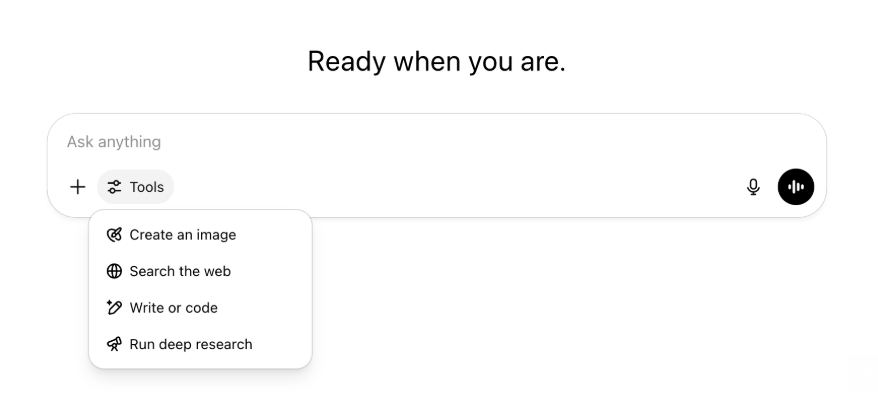
All the same capabilities and tools are still there—just tidier and easier to access in one menu.
May 22, 2025
Releasing GPT-4.1 in ChatGPT
Since its launch in the API in April, GPT-4.1 has become a favorite among developers—by popular demand, we’re making it available directly in ChatGPT.
GPT-4.1 is a specialized model that excels at coding tasks. Compared to GPT-4o, it's even stronger at precise instruction following and web development tasks, and offers an alternative to OpenAI o3 and OpenAI o4-mini for simpler, everyday coding needs.
Starting today, Enterprise and Edu users can access GPT-4.1 via the "more models" dropdown in the model picker. GPT-4.1 has the same rate limits as GPT-4o for paid users.
Introducing GPT-4.1 mini, replacing GPT-4o mini, in ChatGPT
GPT-4.1 mini is a fast, capable, and efficient small model, delivering significant improvements compared to GPT-4o mini—in instruction-following, coding, and overall intelligence. GPT-4.1 mini replaces GPT-4o mini in the model picker under "more models" for paid users, and will serve as the fallback model for free users once they reach their GPT-4o usage limits. Rate limits remain the same.
Evals for GPT-4.1 and GPT-4.1 mini were originally shared in the blog post accompanying their API release. They also went through standard safety evaluations. Detailed results are available in the newly launched Safety Evaluations Hub.
May 15, 2025
Export Deep Research as PDF
You can now export your deep research reports as well-formatted PDFs—complete with tables, images, linked citations, and sources.
To use, click the share icon and select 'Download as PDF.' It works for both new and past reports.
Mobile UI Composer Consolidation (iOS/Android)
We've removed the row of individual tool icons from the mobile composer and replaces it with the new sliders‑style icon to open the Skills menu; tapping that button opens a bottom‑sheet menu where users can choose tools like Create an image or Search the web.
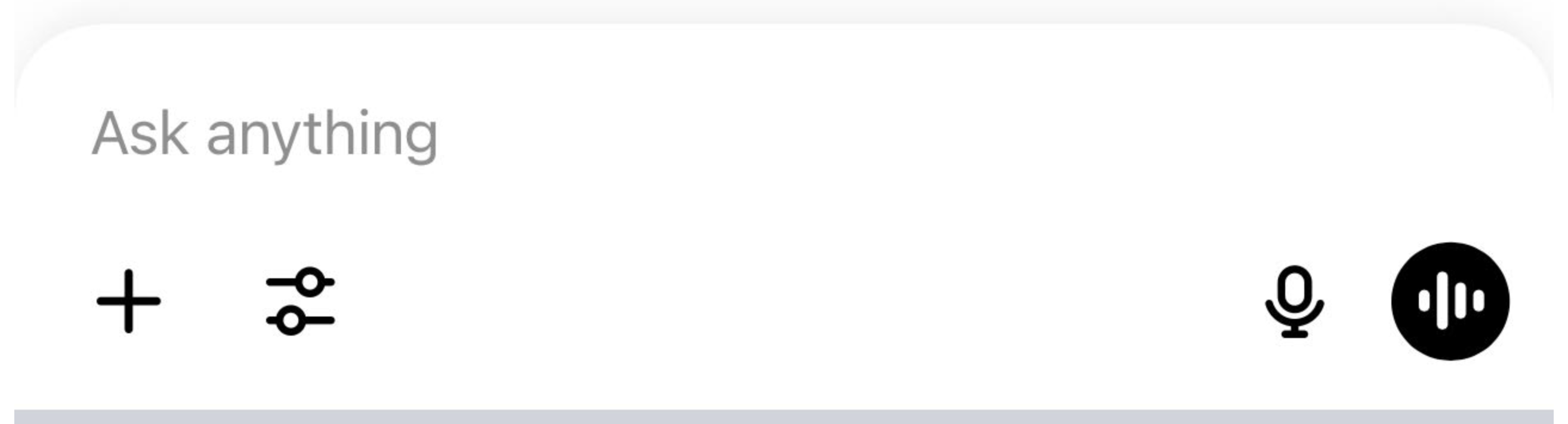
No tools are deprecated—access is simply consolidated to clear space and reduce on‑screen clutter.
May 8, 2025
User Analytics in ChatGPT - GA
The revamped User Analytics dashboard can be accessed in the Manage workspace console in the Analytics tab. It provides more comprehensive data on usage, adoption, and engagement than the original analytics tab.
This improved dashboard gives Admins a high-level view of how ChatGPT is being used across your organization—use it to track adoption and engagement, understand usage patterns for top tools and GPTs, and identify use cases and user trends.
See User Analytics for ChatGPT Enterprise and Edu and Compliance API vs User Analytics in ChatGPT Enterprise/Edu.
May 2, 2025
4o Image Generation in GPTs
GPTs can now leverage ChatGPT’s image-generation capabilities to produce images on demand for users.
GPT creators can enable "4o Image Generation" in the Configure section of the GPT editor, under Capabilities.
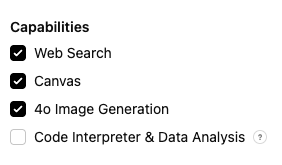
May 1, 2025
Deep research
Users that reach their monthly limit (10 tasks/month) with the standard deep research model will now receive 15 additional requests automatically for that month with our lightweight, cost-effective version until the monthly limit resets.
Learn more about deep research.
Tasks in o3 and o4-mini
You can now create scheduled tasks that enable ChatGPT to run automated prompts and proactively reach out to you on a scheduled basis with o3 and o4-mini. The “ChatGPT with Schedules Tasks” option in the model selector has been removed.
Learn more about scheduled tasks in ChatGPT.
April 24, 2025
o3 and o4-mini
With the introduction of o3 and o4-mini / o4-mini-high, they will supersede o1 and o3-mini / o3-mini-high respectively within ChatGPT.
OpenAI o3 is our most powerful reasoning model that pushes the frontier across coding, math, science, visual perception, and more. It sets a new SOTA on benchmarks including Codeforces, SWE-bench (without building a custom model-specific scaffold), and MMMU. It’s ideal for complex queries requiring multi-faceted analysis and whose answers may not be immediately obvious. It performs especially strongly at visual tasks like analyzing images, charts, and graphics. In evaluations by external experts, o3 makes 20 percent fewer major errors than OpenAI o1 on difficult, real-world tasks—especially excelling in areas like programming, business/consulting, and creative ideation. Early testers highlighted its analytical rigor as a thought partner and emphasized its ability to generate and critically evaluate novel hypotheses—particularly within biology, math, and engineering contexts.
OpenAI o4-mini is a smaller model optimized for fast, cost-efficient reasoning—it achieves remarkable performance for its size and cost, particularly in math, coding, and visual tasks. It is the best-performing benchmarked model on AIME 2024 and 2025. In expert evaluations, it also outperforms its predecessor, o3‑mini, on non-STEM tasks as well as domains like data science. Thanks to its efficiency, o4-mini supports significantly higher usage limits than o3, making it a strong high-volume, high-throughput option for questions that benefit from reasoning.
April 10, 2025
ChatGPT images
Image generation in GPT-4o is now available to all users as the default image generator in ChatGPT. Users who prefer to continue with DALL·E can still access it through the DALL·E GPT.
You can generate images with ChatGPT by simply asking the model to create an image with the details you want, or by selecting the Create image option in the composer. Learn more.
March 31, 2025
User Analytics in ChatGPT - public beta
The revamped User Analytics dashboard can be accessed in the Manage workspace console in the Analytics tab. It provides more comprehensive data on usage, adoption, and engagement than the original analytics tab.
This improved dashboard gives Admins a high-level view of how ChatGPT is being used across your organization—use it to track adoption and engagement, understand usage patterns for top tools and GPTs, and identify use cases and user trends.
See User Analytics for ChatGPT Enterprise and Edu (public beta) for details.
March 20, 2025
Shared Projects Update
We’re holding off on launching shared projects with View and Edit access so that we can work on a more collaborative version that will be valuable to users.
March 13, 2025
Coding with Work with Apps on macOS
When working with IDEs, you can ask ChatGPT to edit open files directly—no copy-pasting required. When you ask for an edit, ChatGPT will generate a diff that you can review and apply, and there’s also an option to automatically apply edits. Diffs are easy to revert in the ChatGPT UI, or by using CMD+Z in your editor.
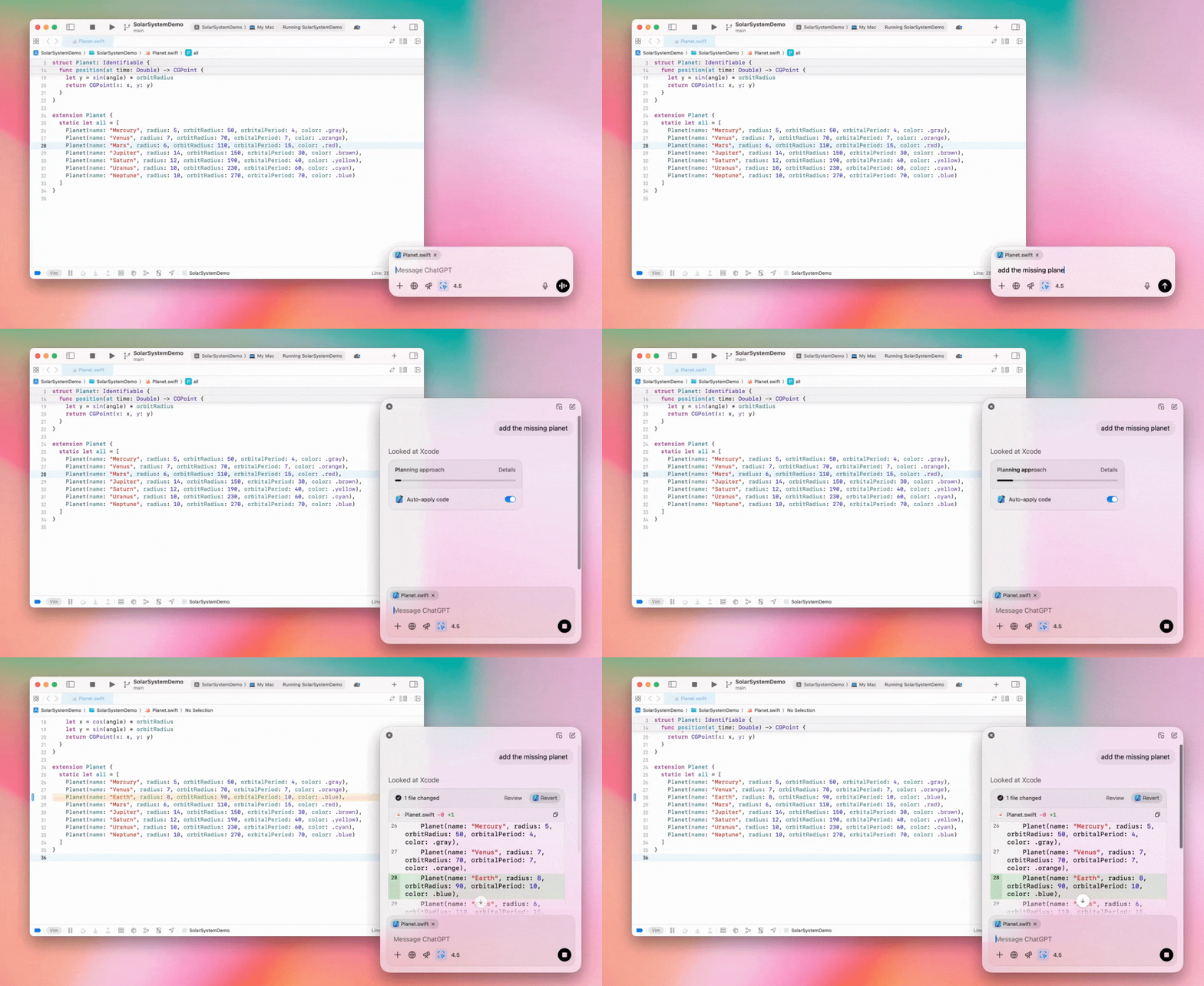
Enterprise admins can flip the "Work with Apps" toggle off in their Admin Settings to disable this functionality for their workspace members.
GPT-4.5 in ChatGPT
As of March 13, 2025, users in Enterprise and Edu plans will now be able to use our GPT-4.5 model in ChatGPT!
See GPT-4.5 in ChatGPT for details.
March 10, 2025
Deep research in Compliance API ChatGPT
As of March 10th, 2025, for Enterprise customers using the Compliance API your options include:
Search for the "deep research global prompt".
Look for the tool name in the response look for
{"tool_name":"deep_research"}.
February 25, 2025
Deep research in ChatGPT
In ChatGPT deep research is now available to users on the Enterprise plan.
Deep Research allows ChatGPT to agentically and asynchronously browse the web to complete your professional or personal work.
Enterprise, and Edu users will have 10 deep research queries per month.
See our Deep research FAQ for details.
February 13, 2025
o1 pro mode and o3-mini in ChatGPT
In ChatGPT o1 pro mode is now available to Enterprise and o3-mini to Enterprise Edu!
o3-mini: OpenAI o3-mini has replaced o1-mini in the model picker. It’s more cost effective and offers higher rate limits at lower latency. It’s a reasoning model, making it a great choice for coding, STEM, and logical problem-solving tasks. o3-mini shows its chain of thought, and can browse the web.
o1 pro mode: Also available in the model picker this week is o1 pro mode. Designed for accuracy and depth, it excels in research, engineering, business, and law—ideal for professionals tackling highly complex challenges. O1 pro mode will take longer to think through a problem. So responses can take some time. Due to its computational intensity, each user is limited to five queries per month. For most tasks, o1, o3-mini, or GPT-4o will remain optimal choices.
Re: File Uploads
Images, docs, and pdfs are supported in the o1, o3-mini, and o3-mini-high models. No spreadsheets (csv/excel).
Only images are supported in o1 pro mode. No docs/pdf and no spreadsheets (csv/excel).
Canvas Sharing
ChatGPT Enterprise and Edu users can now share a Canvas asset such as rendered React/HTML code, document, or code with another user, similar to how you share a conversation. You can do this from the Canvas toolbar when Canvas is open.
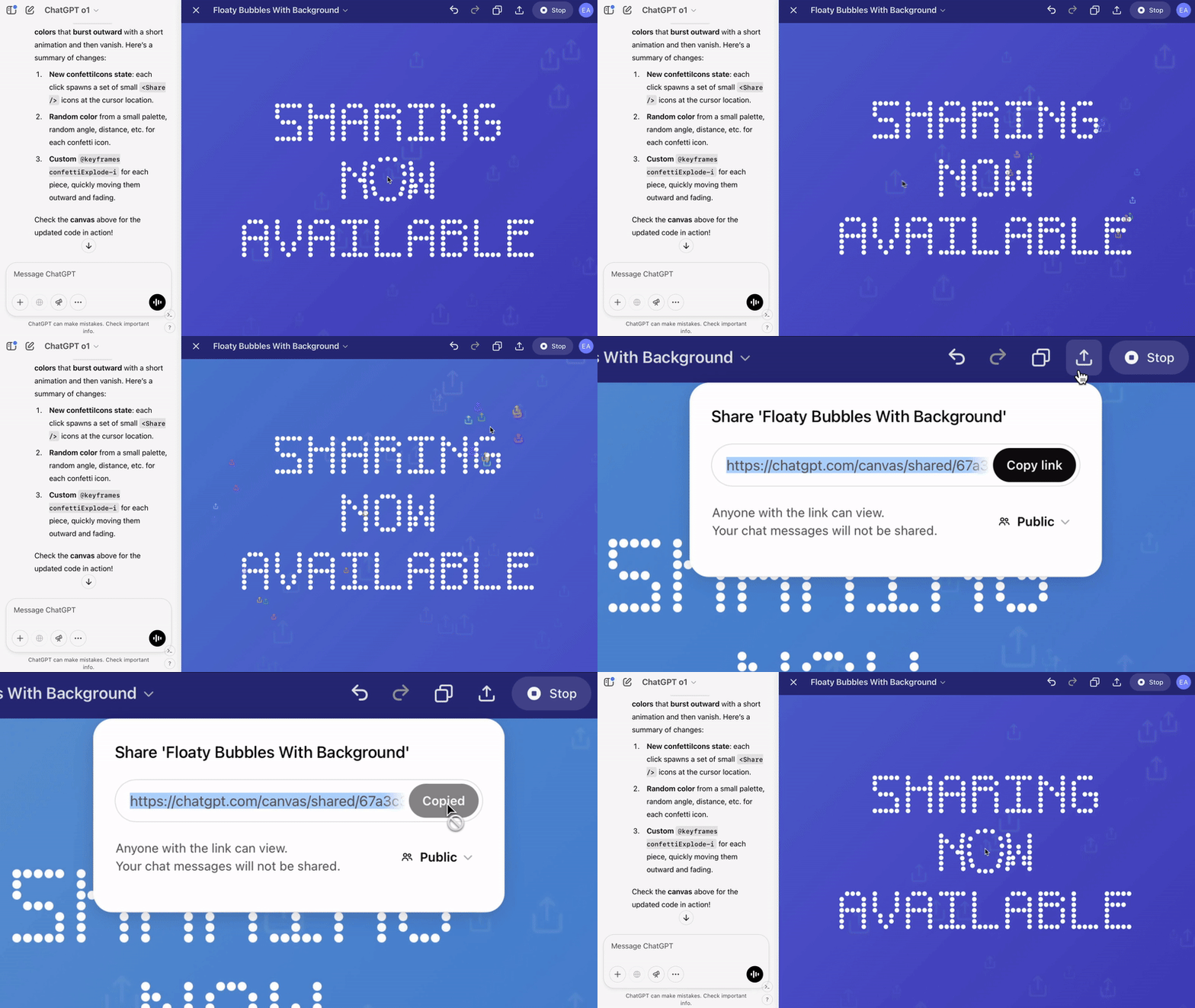
For more details about the canvas feature in ChatGPT, check out the following Help Center article!
January 23, 2025
Projects
Projects are now available for all paid plans including Enterprise and Edu.
See Using projects in ChatGPT for details.
January 16, 2025
Visual Retrieval (PDFs) for ChatGPT Enterprise
ChatGPT Enterprise now supports reading and understanding visuals (images, graphs, diagrams, etc.) embedded in PDF files. Users can upload a PDF, and ChatGPT can interpret the text and any visual elements within that file.
For details see Visual Retrieval with PDFs FAQ.
December 12, 2024
o1
Starting today, all ChatGPT Enterprise customers will be able to access o1 through the model selector, replacing o1-preview.
o1 can now be used to reason about image uploads, opening up new applications by analyzing and explaining visual representations with more detail and accuracy. We have also trained the model to be more concise in its thinking, resulting in faster response times than o1-preview.
December 11, 2024
Apple Intelligence with ChatGPT
ChatGPT admins can now enable and disable access to Apple Intelligence from their workspace admin settings, under Connections.
If this setting is toggled off, users cannot select their ChatGPT Enterprise/Edu workspace when logging in with their OpenAI credentials.
December 10, 2024
Canvas
Today we made Canvas available in 4o by default for all users, Free and Paid. Additionally, we launched a number of new capabilities for canvas, including:
Canvas in GPTs: Canvas can now be used with GPTs when enabled in the GPT creator. This toggle will be enabled for newly created GPTs by default.
Python code execution: You can now execute Python code in a canvas. ChatGPT will take a pass on fixing bugs in your code and provide comments on errors. Please note that executing Python can make external network requests, and Enterprise workspace admins can disable Python code execution by toggling the Canvas code execution setting in their Admin settings. This is turned off by default for all Enterprise accounts.
Canvas shortcut: You can now paste content into ChatGPT and instantly open it in canvas via a shortcut in the upper right corner of the composer.
Canvas in Toolbox: Canvas has been added as an option in the toolbox.
Workspace admins can now use the Compliance API to get, list, and delete canvas text documents.
Please note that the Admin Setting to disable canvas has been removed, as this feature is now out of beta. If this was previously disabled, we will continue to honor that setting. Please contact support@openai.com if you would like to update this setting for your Enterprise/Edu workspace
December 3, 2024
Work with Apps on macOS
ChatGPT can now read content from your coding apps, bringing you smarter, more accurate answers tailored to your work by using Work with Apps on macOS. Learn more about Work with Apps on macOS.
Enterprise admins can flip the "Work with Apps" toggle off in their Admin Settings to disable this functionality for their workspace members.
November 22, 2024
Updates to the ChatGPT Web experience
We are rolling out the following updates over the next two weeks to all ChatGPT users.
Sidebar redesign
New floating mode added with soft dismiss behavior
Recent conversations are now limited in the sidebar, with an unlimited infinite scroll flyout for all conversations
Recent GPTs & Pinned GPT's are now displayed below conversations
Settings are now always in the bottom of the sidebar
A small settings icon was added in larger viewports when the sidebar is not open
New transitions were added to create a more immersive feel
Other updates for ChatGPT on Web
The core underpinnings of the site were revamped, offering much better support for a larger variety of devices and sizes
Initiating a new conversation now scrolls it into view at the top of the screen
Initiating a new conversation no longer auto scrolls to the bottom while the message is generating
The sidebar when pinned can now stay open with an active Canvas if enough space is available
A new composer bar layout now fades content underneath it as you scroll with an updated look & feel
The new chat button has been moved to the left of the Model Picker to be easier to access
The system icon in conversations has been removed to make additional horizontal space
Dall-E focused view has an updated layout
GPT Creator has an updated layout
Improved Mobile Web Experience
The experience with the on-screen keyboard on mobile devices has been greatly improved across iOS & Android devices
The new sidebar is always in floating mode and auto closes when switching threads
We no longer focus the composer on mobile web when switching conversations
An issue causing scroll to get stuck in certain situations should be resolved
November 20, 2024
Update to GPT-4o
We’ve updated GPT-4o for ChatGPT users on all paid tiers. This update to GPT-4o includes improved writing capabilities that are now more natural, audience-aware, and tailored to improve relevance and readability. This model is also better at working with uploaded files, providing deeper insights and more thorough responses.
November 19, 2024
Advanced Voice for ChatGPT Web
Starting today, we’re beginning to roll out Advanced Voice Mode on web (already available on mobile and desktop apps). Users can now start a voice chat on chatgpt.com on their desktop and have real-time, natural conversations with ChatGPT while doing tasks like, planning, writing, and brainstorming.
November 14, 2024
Windows App
The improved Windows app is now available through the Microsoft Store for ChatGPT Enterprise and Edu workspaces. ChatGPT users that are familiar with our experience on the web can seamlessly integrate the Windows app into anything they’re doing on their computer.
User access to the ChatGPT Windows app will follow your IT admin’s policies for apps in the Microsoft Store. In the coming weeks, IT admins will also have the option to deploy the app to employee devices via MDM/MAM, rather than allowing direct downloads from the Store.
As with any ChatGPT Enterprise experience, user chat history is secure and will not be used to improve OpenAI's services.
Learn more about the ChatGPT Windows app.